AI agent control plane · self-hosted · independent
The self-hosted control plane for AI agents
DataShield is the self-hosted AI agent control plane for regulated work. Every tool call authorized. Every dataset tokenized. And every action provable. DataShield is one platform for AI agents. It designs governed applications. It authorizes the agents inside them. It runs the coding-agent fleet that builds them. And it serves those agents governed data and knowledge. All of it runs on servers you control.
Auth, Commander, Ontology, Corpus and Blueprint are five products that behave like one. Below is the story of a single run through all of them.
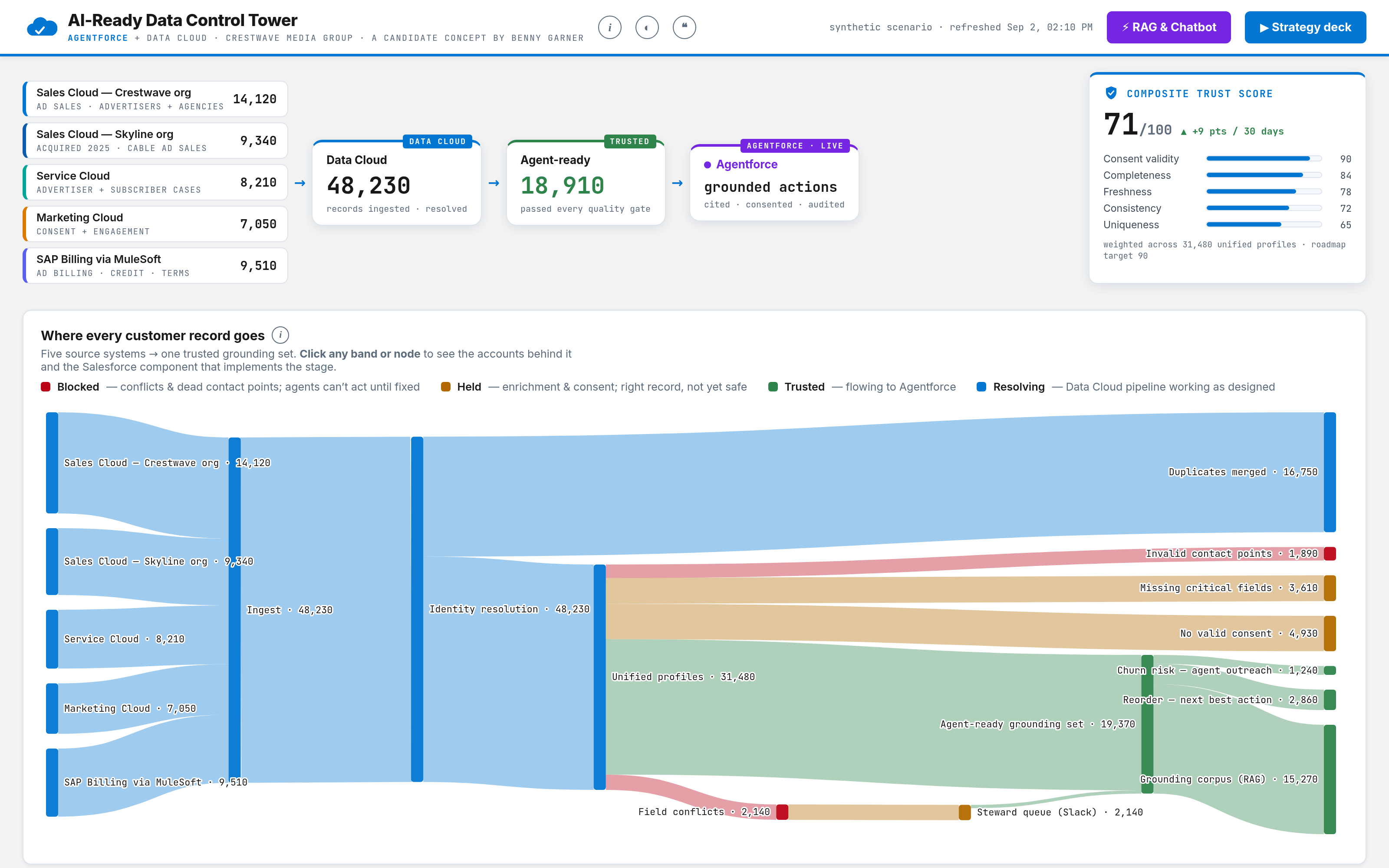
What the platform is, in four words each.
The gap nobody's firewall closes
An AI agent is a new kind of user. It holds credentials. It reads production data, calls tools and writes code. It does all of that at machine speed. The person behind it isn't watching every step. In a hospital, a bank or a plant, that's a control problem first. A productivity story, second.
The tools that govern people do not fit. Your identity provider knows who the agent belongs to. It does not know what the agent may call right now. A data catalog knows where PII lives. It does not know that an agent just read it. A deploy pipeline knows a commit shipped. It does not know which agent wrote the commit. It does not know what anyone told the agent to do. DataShield closes that gap as one system, not five point products. It also leaves behind proof a third party can check, without trusting us.
One run through the self-hosted AI agent control plane
Blueprint composes a signed application definition. Auth verifies it and registers the app. Auth then issues scope-ceiling tokens to its agents. Commander provisions the app as a project. It runs the agents from personas you approved. Ontology serves them classified, tokenized, mastered data. Corpus serves them docs and skills. Each checked call lands in the evidence lane.
Two rules hold across all five products. First, reads go through Auth. An agent never touches data or knowledge with credentials of its own. Second, nothing an agent says moves anything. Only a verified definition moves anything. Or a checked call. Or a promotion that passed its ladder.
Five products, one platform
Auth
The authority. MCP tool tokens carry a scope ceiling an agent cannot exceed. Auth authorizes each call at dispatch. A revocation caught mid-session ends the session. Auth writes each decision to a hash-chained audit log with Ed25519 checkpoints. Anyone can verify it. Break-glass is a first-class path with its own evidence. Explore Auth
Commander
The cockpit. Run fleets of Claude Code sessions per project. Launch them from personas with boot prompts you approved. Transcripts stay in your own PostgreSQL. A dev, test, prod promotion ladder halts on a dirty tree. It records the operator who overrode it. Explore Commander
Ontology
The data plane. A catalog scans live sources in place. It classifies PII and PHI by column. Ontology tokenizes data at ingest. It masters records into agent-ready golden data. An admission gate checks quality and consent before an agent may read. Agent-led model building comes included. Explore Ontology
Corpus
The knowledge engine, also known as the Cuppy.io engine. It's a curated docs hub, a versioned skill-pack library, and a governed MCP service layer with role tiers. Agents load packaged expertise and read the right docs instead of guessing. Corpus publishes signed agent manifests for discovery. Explore Corpus
Blueprint: applications that are governed by construction
Blueprint starts an app from its favicon. Pick or generate a mark, then choose a validated palette. Blueprint derives a full theme and assembles a signed AppDefinition. That's the governed document. Auth verifies it. Commander provisions it into a running app. A rule set checks each colour claim. Blueprint records each step. Nothing ships unverified.
That is what we mean by a blueprint-able app. It is not a template. It carries its own provenance. It carries its own entitlements. It carries its own audit trail from the first pixel. It runs on the same plane as everything else on this page. The two apps pictured below run on this platform today. The same Auth, data and evidence plane sits underneath them.
What it looks like
Real screens from running instances. No mockups.
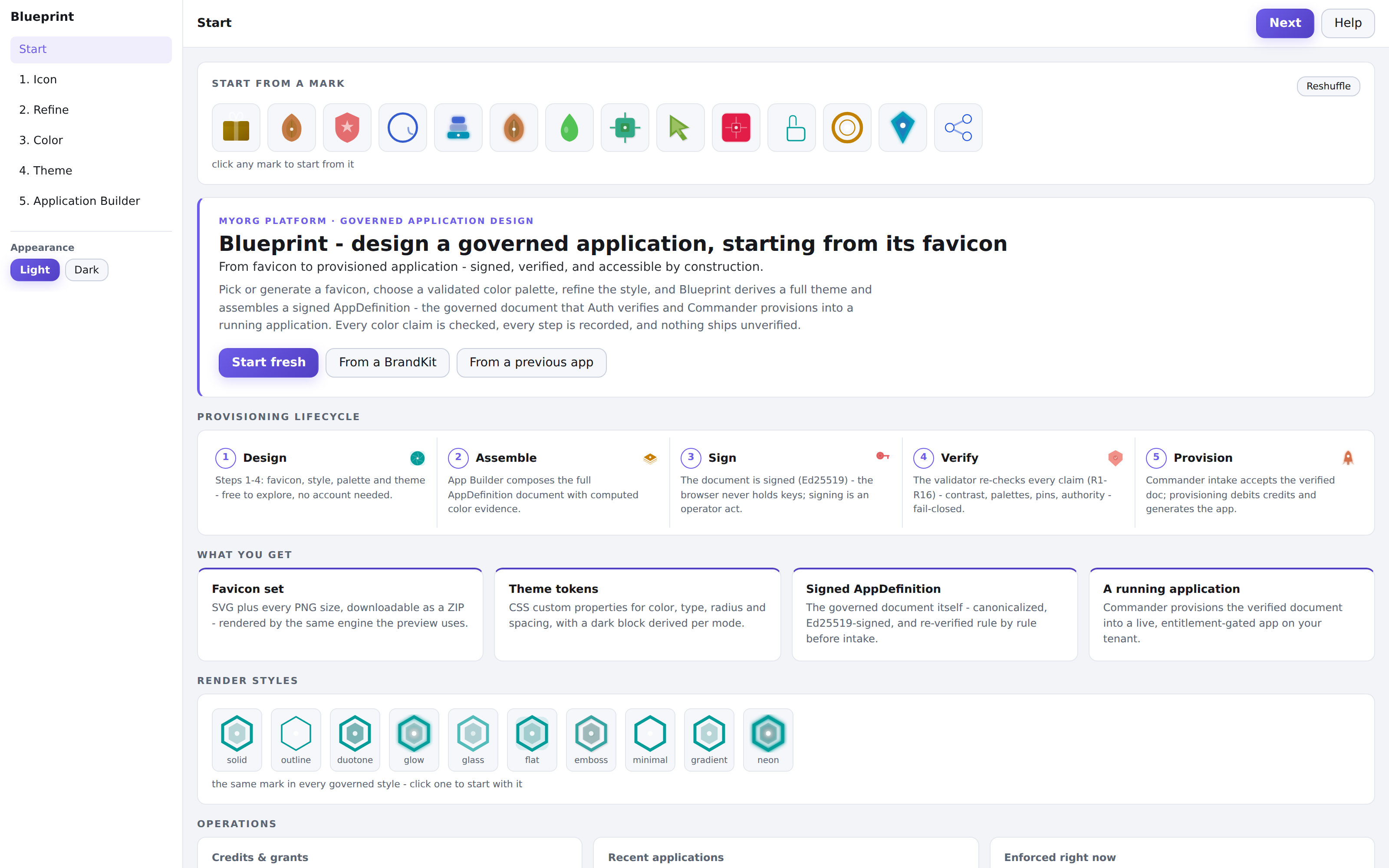
Blueprint
From favicon to a provisioned app in five recorded steps. They are design, assemble, sign, verify and provision. Auth checks the signed AppDefinition. Commander runs it.
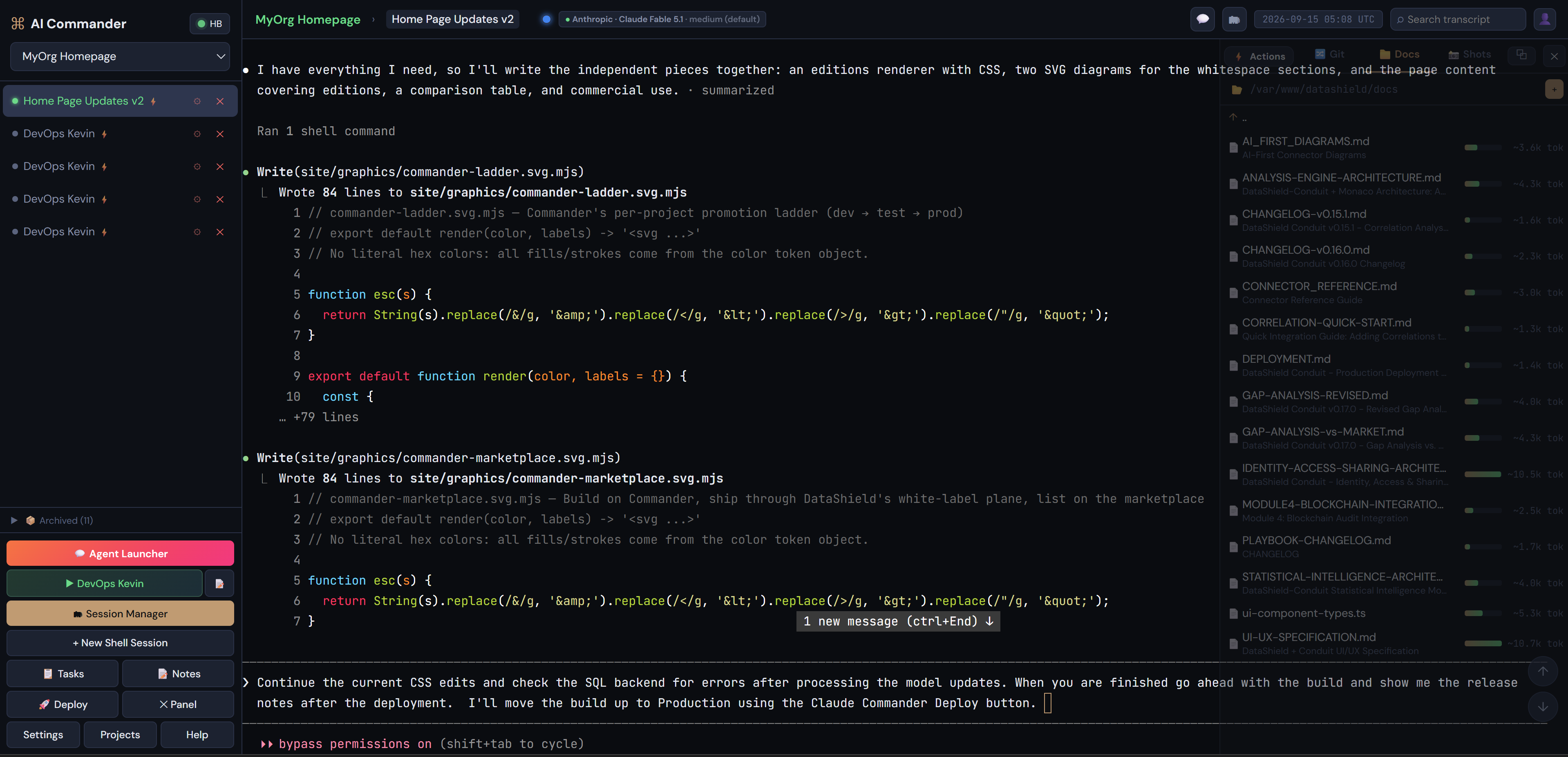
Commander
Each agent session is a tab. It has a name, a persona and a kept transcript. The docs panel on the right holds the project's own knowledge. It serves the agent.
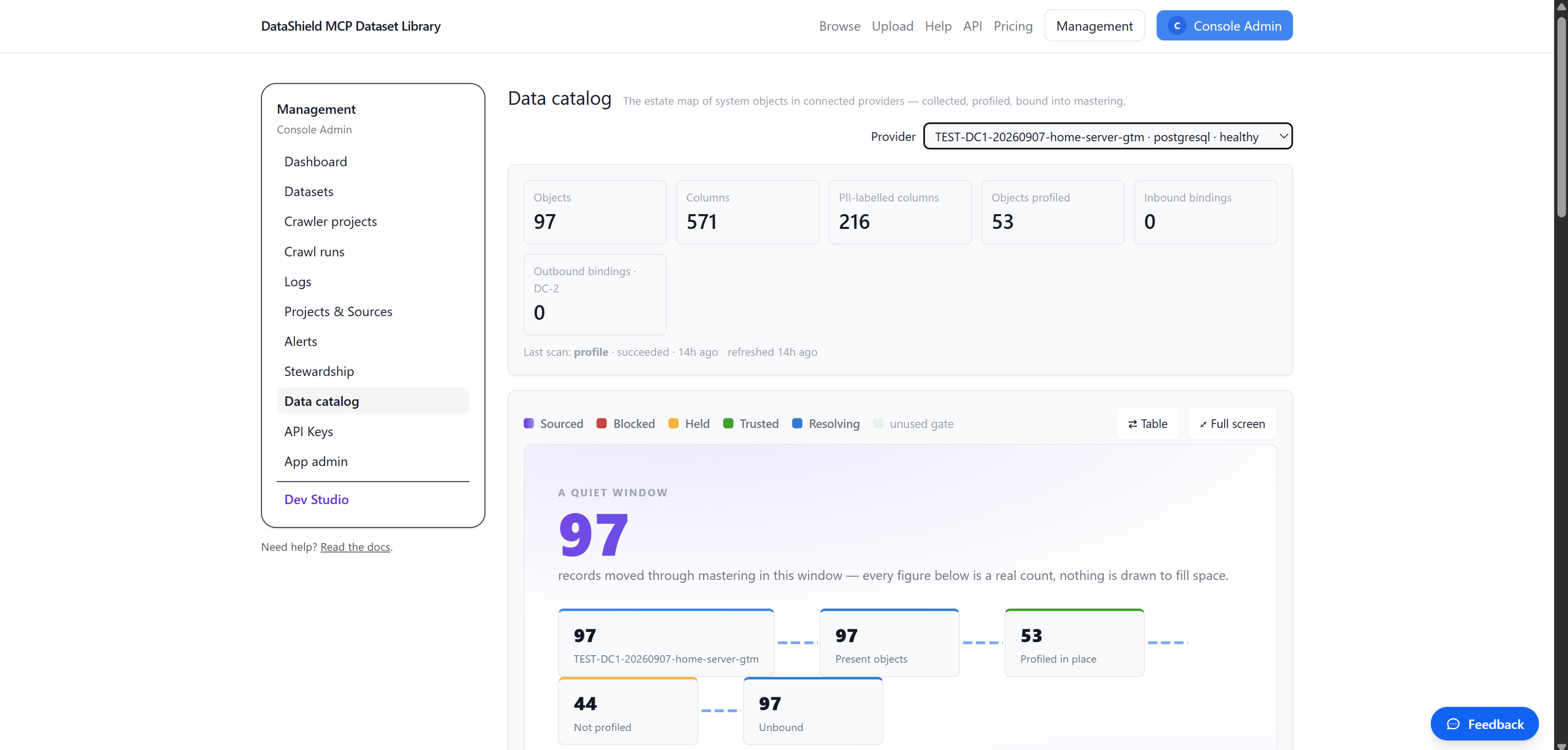
Ontology
A live estate map: objects, columns, PII-labelled columns and profiling status, per source. In the mastering flow, each figure is a real count.
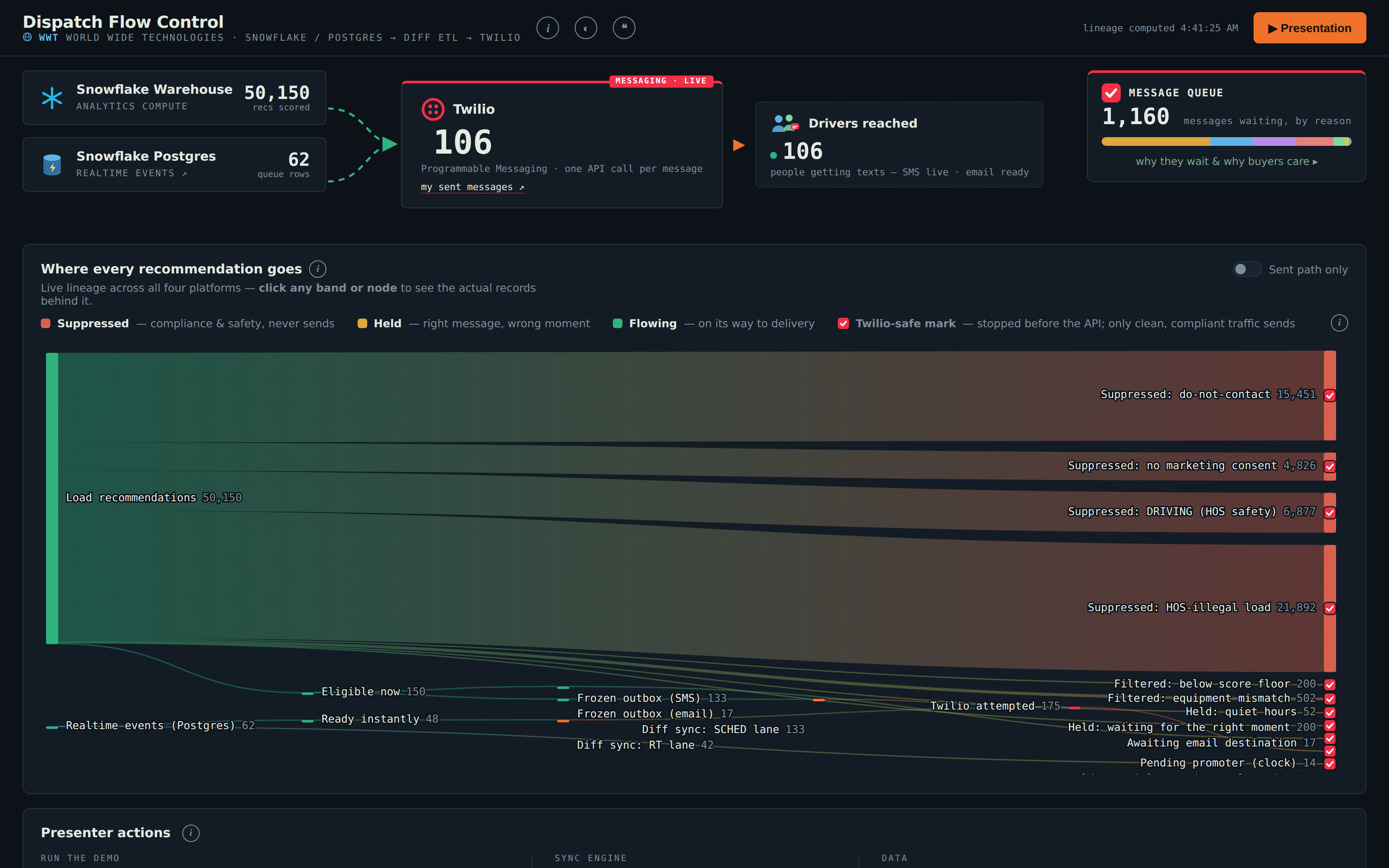
An application in production
Dispatch Flow Control routes recommendations from Snowflake and Postgres into Twilio. It holds 1,160 of them on purpose: no consent, no contact, wrong moment. The lineage is visible for each band.
Built for regulated deployments
We map each alignment claim, control by control, on the compliance page. Items marked as in progress are roadmap, not marketing.
Deploy it your way. Most teams start hosted.
Ask us how to run DataShield and the first answer is SaaS. We stand up your instance, operate it, patch it and watch it. You get a login in days, not a procurement cycle.
It is single-tenant SaaS, which is the premium kind. Your instance runs on dedicated resources. No noisy neighbours, no shared control plane, no other customer's traffic on your box. Your signing keys stay on your instance, under your control. Your transcripts, chains and data stay in your own PostgreSQL. You get the convenience of hosted software with the isolation of your own server. That's exactly what regulated buyers ask us for.
When SaaS is the wrong shape, the same platform runs everywhere else. Self-host it in your own cloud or data center. Run the Commander editions from a Docker image on your own machines. Or take the Enterprise route: an air-gapped private cloud. Same code, same evidence chain, same keys. Only the address changes.
There is one more thing a hyperscaler cannot offer. Your firewall company, your warehouse vendor and your model vendor don't own DataShield. The party generating your evidence is not the party you are auditing. An auditor can verify the chain with a public key and a script. They need no account on our system. Try the verifier on a sample chain. Then read how it compares with the vendors you already know.
Whichever lane you pick, it's the same self-hosted AI agent control plane. One codebase, one evidence chain, keys held on your instance.
Questions buyers ask first
What is an AI agent control plane?
The layer that decides what an agent may call right now. It records what the agent did. It can stop the agent mid-session. In DataShield, Auth is the control plane for authorization and evidence. Commander operates the agents. Ontology governs the data they read. Corpus governs the knowledge they load.
Is DataShield SaaS or self-hosted?
Both. Most customers start with SaaS. Ours is single-tenant. Your own instance, on dedicated resources, operated by us, live in days. Your keys stay on your instance. And your data stays in your own PostgreSQL. No shared control plane, no noisy neighbours. The same platform also self-hosts in your cloud or data center. It runs from Docker, or deploys air-gapped on Enterprise.
Does it work with Claude Code and other MCP clients?
Commander runs on Claude Code sessions. Auth authorizes any MCP client that presents its tool tokens. Ontology and Corpus are MCP servers. DataShield can govern any agent that speaks MCP.
How is the audit evidence verifiable?
Auth appends each authorized call to a hash chain. It signs periodic checkpoints with an Ed25519 key. A verifier recomputes the chain and checks the signatures. Deletion or edits break it. You can run the check yourself on the verify page.
What is a blueprint-able application?
An app built from a definition. Blueprint composed it and signed it against a validated rule set. Auth then verifies and registers it. Commander provisions it into a running project. It carries its provenance and entitlements from the start.
Can I build and sell a product on this platform?
Yes, on Enterprise terms. You get white-labelled hosting under your brand. Plus the signed license plane, process supervision and Auth. We list your product on the DataShield marketplace. Agency work counts as commercial use. The Commander page has the details.
The stack
Auth
Authorization and evidence for AI agents. You get scope-ceiling MCP tool tokens, break-glass, and a hash-chained audit. v2.4.1, live now. Explore Auth
Ontology
The governed data plane. It holds the catalog, PII/PHI classification and tokenization at ingest. It adds agent-led MDM and golden records over MCP. v2.2.0, live now. Explore Ontology
Commander
The operations cockpit for coding agents. Many Claude Code sessions per project, personas, kept transcripts. A promotion ladder with an audited override. v3.0.15, live now. Explore Commander
Corpus
The Cuppy.io knowledge engine. A docs hub, a skill-pack library, a governed MCP service layer for agents. v1.3.2. Explore Corpus
Auth v2.4.1, Ontology v2.2.0 and Commander v3.0.15 are live now. Blueprint provisions through Commander. The evidence page is provable agent compliance.
See your own agents governed, from the first favicon to the last audit checkpoint.
Get an instant quoteYou've seen the proof
Ready for a number? Scope your deployment and we'll price it against your own economics.
Get your quote →